Corrosion and cathodic protection
Why metals corrode, how cathodic protection slows it down, and the AMAC Corrosion products that make it work.
Metallic corrosion
Metallic corrosion is the deterioration or destruction of metals and alloys through electrochemical reactions. All metals tend to return to a stable condition.
Metals that actively seek a stable condition have lower potentials and are the most prone to corrosion (anodic). Metals that passively seek a stable condition have higher potentials and are less prone to corrosion (cathodic).
Metals can be classified by their tendency to dissolve. Table 1, the galvanic series of metals, ranks them by their potentials measured against a reference electrode.
- PlatinumLeast active
- Gold
- Carbon (graphite)
- Titanium
- Type 316 or 304 stainless steel (passive)
- Monel metal (70% nickel, 30% copper)
- Silver
- Nickel
- Lead
- Bronze, copper, brass
- Tin
- Lead/tin solder
- Type 316 or 304 stainless steel (active)
- Cast iron / mild steel
- Cadmium
- AluminiumAMAC anode
- ZincAMAC anode
- MagnesiumAMAC anode
Top: least active, high potential (cathodic). Bottom: most active, low potential (anodic).
Cathodic protection
The aim of every cathodic protection system is to reduce the rate of corrosion of the cathode by promoting the flow of electrons from the active anode to the passive cathode.
The anode supplies the current. There are two ways to do it.
Sacrificial anode systems
The anode supplies the current and gradually corrodes as its ions dissolve into the electrolyte.
Sacrificial anodesImpressed current systems
The potential difference is created by a low voltage DC current.
Impressed current anodes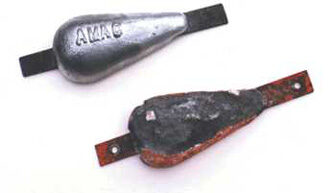
Calculating sacrificial anode requirements
Need a design, or help designing a sacrificial anode system? Contact us, or the Australasian Corrosion Association, which has an extensive range of reference books, courses and other information.
Not sure which system you need?
Tell us about your structure and environment. We’ll help you choose the right anodes and equipment, made at our Kilsyth factory.